Thursday, June 7, 2012

West Africa Odyssey 2012 - Cameroon


Cameroon: Kribi, Limbé and At Sea in the Doldrums

April 8 - 10, 2012
Aboard National Geographic Explorer

Sunday, April 8 we arrived in Kribi, Cameroon in the afternoon as it took us a day and a half from Principé. It was another zodiac landing onto a pier, and we took our life jackets with us to use later on a river trip.

Our group first visited a bilingual primary school where the students are taught in English. There is high demand for English in Cameroon and the school can only accept so many students as they have limited classrooms available – each holding 30. They will build more rooms as money becomes available. The students pay about $100 annual tuition. The ship donated some school supplies to this privately run project.

Grace with local artist
We went to see a waterfall on the Lobé River. The walkway was badly washed out due to recent high tides. I scrambled far enough along to see the falls, however.

Our last activity was to take a “pirogue” or dugout canoe ride up the Lobé River to visit a group of “Bagyeli” people. Translated that means “little people” and the term “pygmy” is not used any more. There were about eight boats that were paddled and poled along up river for about 40 minutes. The tribal chief greeted us and the men and women performed some interesting dances.

Grace meets the Bagyeli Chief
By then we were running late and it was almost dark by the time we returned to the boarding site and climbed onto the buses for the drive to the dock. The 1 ½ mile zodiac ride back out to the ship was in total darkness, except for the spot light from the ship. The wind had picked up so it was also a fairly wet ride. Fortunately, the water was warm and the air was still warm so we weren’t cold.

Monday, April 9 was another landing by zodiac in Limbé. From here on we will dock at a pier so no more zodiac landings.

Banana production and marketing has many stages
The Limbé visit included a banana growing and packaging plant. As with many things in Africa, we had discovered that well planned events don’t always go as scheduled. We had to wait for someone in authority to come to explain the operation. It was interesting to learn how the bananas are grown, how long it takes before they can be picked, about 8 – 10 weeks, and then they are sorted and packaged for shipment – mostly to Europe – where they will ripen along the way. We left with four big boxes of bananas for the ship, which made us all happy.

We next visited a Tea Plantation and watched how they dry and process the tea for packaging; done at another location. We got to taste the tea and it was good.

After lunch at a hotel, we made a stop at the Limbé Wildlife Center jointly run by the Ministry of the Environment and Pandrillus, a primate charity. They take in rescued gorillas, chimpanzees, mandrille and twelve other primate species. All animals are housed by family groups in spacious environment appropriate enclosures. The goal is to be able to reintroduce family groups back into the wild. There were many species we had never seen before, even in zoos.

Some went back to the ship, including Paul, but I went on to see the Laval Flow from the 1999 eruption of Mt. Cameroon. The walk/climb wasn’t too difficult and there was a nice view. There were more recent eruptions, which flowed in a different direction.

National Geographic Explorer, our home for five weeks
Again, it was dusk when we boarded the zodiacs for the ride back to the ship. I had sent my backpack with Paul, but a nice lady had a plastic bag to protect my camera. It was a good thing because the ocean was rough and the transfer from zodiac to ship was precarious and very wet; all fun stuff for us adventurers. ;-)

Tuesday, April 10 we were all ready for a day at sea. It was filled with lectures, but the big push for me was to get my slide show ready for the 3:30 presentation. It was my first showing using the new software, Adobe Lightroom, which I bought a few weeks before leaving Portland. I like the program and did not have any difficulties other than having to decide which pictures to show in the three minutes allowed. There were about 15 who presented including at least five or more using their iPads. Passengers just walk around the lounge and view each show, then move on to the next. It took about an hour to see all of them. I received lots of nice compliments on my pictures.

For those of you who may have wondered about the safety of traveling in the waters off West Africa, I can assure you that Lindblad has planned for anything that may happen. We had aboard a security team, which was on watch 24/7, and were heavily armed. There has never been any pirate attack on a passenger vessel in West Africa, but we appreciated the security, none-the-less.

During this Day at Sea, now heading west, we sailed past the first of only four countries where we did not stop along the whole west coast. This one was Nigeria. The others we will skip will be Ivory Coast, Guinea and Mauritania. The reasons are mostly because of safety concerns and political unrest. Before dinner we had the “We’re Halfway!” Cocktail Party with Captain Oliver Kruess.

The next day we arrived in Benin followed by Togo and Ghana filling four days of shore excursions before any more days at sea.

That's it for now. Grace and Paul

Wednesday, June 6, 2012

West Africa Oddysey 2012 - Sao Tomé & Principe


Island Country: Sao Tomé and Principe

April 6-7, 2012
Aboard National Geographic Explorer


St. Nicolau Waterfall
Friday, April 6 we spent the whole day on the largest mountainous island, Sao Tomé, of this island country – the smallest country in Africa. It was our first experience in a dense rain forest. They grow coffee and cocoa and have lots of other lush plants; almost all of them came from the “new world, or western hemisphere.” The whole day was a series of long drives; to see a waterfall way up in the mountains, to see an old coffee plantation, to eat at an out-of-the-way restaurant, and the hit was the Chocolate factory for some sampling and purchases. We experienced a heavy rain shower, which didn’t last more than a ½ hour, but made for a wet entrance to the lunch location.
One stop was to visit the BomBom Church where a special concert by the men's choir had been arranged for us. It was very delightful.
Some went on a birding excursion, but such isn’t our priority. Some got to visit the “Voice of America” broadcast facility, but that wasn’t on our tour. While I went back to the ship Paul went with a few others to visit a market.

Bom Bom Resort
Saturday, April 7 the weather continued hot and humid. We arrived at the island of Principe about 11:00 am, but it took a long time for the officials to come aboard to clear the ship (we find that officials in Africa march to their own drummer, and generally show up to clear us through customs and immigration whenever the mood strikes them despite our prearranged schedule).
 We spent the whole afternoon on the island just relaxing at the Bom Bom resort, which is owned by a wealthy South African citizen who has done his own space exploration. (He has now sent the first private space capsule of cargo to the Space Station.) It was a beautiful site and it was our only chance on the trip to go snorkeling or swimming. While I did have snorkeling gear I didn’t use it. Rikki and I did go out swimming for a short while just to have some time together and hang out. The best thing was that it cooled our body temperature down and made the rest of the afternoon more bearable. 

Returning from soccer game
Paul decided not to get in the water, but he did take the bus ride into the town, a half-hour drive each way. When they got there the town was practically deserted. Soon people started pouring in, coming from the big football (soccer) game between Sao Tomé and Principe. Fortunately, Principe won. There was a market area with lots of friendly people and Paul likes taking those kinds of pictures.
Grace, Richard and Mary Ann

I just hung out and read some of my book and visited with friends. There was a huge downpour for about a half hour and then it was back to a normal somewhat overcast, but hot and humid day.

Happy Hour and a BBQ dinner were supposed to have been on the beach, but they didn’t realize that a full moon high tide would cover most of the beach, so we returned to the ship where they did the BBQ on the back deck.

We had to set our clocks ahead an hour that night. The next two days we were in Cameroon where we will have a chance to meet the “Bagyeli” people (they used to be called pygmies). It promised to be a very interesting two days.

That's it for now. Grace and Paul

Tuesday, June 5, 2012

West Africa Odyssey 2012 - Congo & Gabon


Congo

Congo: Pointe Noire, At Sea, Gabon: Libreville

April 3-5, 2012
Aboard National Geographic Explorer

Tuesday, April 3 in the Congo, everything was still going very well. We were staying healthy and the seas had been quite calm. The weather got much warmer and more muggy the farther north we went.

Paul and Grace at Diosso Gorge
 We had a couple of lectures in the morning because we did not arrive in Pointe Noire, Republic of Congo, until after lunch. Now we had traveled from countries, colonized by the Portuguese, where they spoke that language, to the Republic of Congo, which was colonized by the French. They speak French. We visited a canyon area, the Diosso Gorge, which is their version of the Grand Canyon. There was also a stop at a local Artisan’s Market where nothing reached out and said I must buy it. I didn’t even take any people pictures because they were very fussy and required permission before taking pictures. Paul is very good at that, but I’m a little shy about it.
Dolphins riding the bow
After dinner we went to a concert by a local group. It was probably not our favorite African music; I’ll just leave it at that.

King Neptune Ceremony
Wednesday, April 4 was a full day at sea. There were a couple of lectures and they handed out snorkeling gear, which was for use at Principé. In the afternoon they had the official “Equator Crossing” ritual. King Neptune visited on the back deck and those who had not crossed the equator on a ship were initiated. Actually, they picked representative people from the crew, staff and passengers. It was very messy. Passengers later had a chance to submit a few of their pictures to the photo team and then after dinner we went to the lounge where the pictures were critiqued. Next time I’ll submit some. We passed over the equator close to midnight.

Gabon
Thursday, April 5 we were in Libreville, Gabon. It is an interesting country, ruled by the son of a long time ruler. After stops at the oldest Protestant mission and Catholic mission we went to a nice hotel on the beach for lunch. 

The US Ambassador to Gabon, who is from Oregon, greeted us. He talked about the function of the embassy and how it helps Americans and American companies in Gabon. He also told us that they have just formed a partnership with the University of Oregon that will host student exchanges and provide environment and conservation studies. Gabon has set aside 10% of its land for national parks and is working toward a growing tourist industry. The US Ambassador to Cameroon was also there as was a representative from the State Department in Washington, DC. They were in Gabon for an Environmental Conference, which included a number of the neighboring counties. Its purpose was to address the poaching and trafficking problems in the area. Evidently the Sudanese had killed hundreds of elephants recently for their ivory. After lunch we were in the group that “got to” see the American Embassy. When we signed up, we didn’t realize that we would be taking a walking tour around the construction site for the new embassy, which is scheduled to open in August. That was a disappointment as we thought we would see a working embassy.
US Ambassador to Gabon

Over the next two days we were on the islands of the small island nation of Sao Tomé and then Principé where they speak Portuguese. These islands played a huge role in the staging of Africans for the slave trade. There will be more about that in my next message.

We enjoyed getting to know and spending time with a lot of interesting people. In my free time I was busy trying to stay on top of picture downloading and editing.

That's it for now. Grace and Paul

West Africa Odyssey 2012 - Angola


Angola: Lobito and Luanda

April 1-2, 2012
Aboard National Geographic Explorer

We enjoyed experiencing Angola, which just ended a recent civil war. Because of that war it has only the beginnings of a tourist industry. This made our arrival, immigration and customs procedures more challenging because they really didn’t know what to do with a passenger ship.

Sunday, April 1 we pulled into the large deep-water port of Lobito, Angola in the southern part of the country. Although port pilots were requested to board the ship at 6:00 a.m. they showed up much later and, as with Namibia, they wanted to do a “face check” for all passengers and staff. This meant that we got our passports, went to the Chart Room and had them individually stamped. Fortunately, the ship’s purser keeps our passports, so we don’t have to worry about where we placed them.

Angola was under Portuguese rule from the mid 1800s until it became independent in the early 1970s. That touched off a 27-year long civil war that ended in 2002. Lobito has started the process of reconstruction and is on a path to development.

The passengers were divided into two groups. Our group boarded buses and was driven through the town and countryside to Benguela. There were signs of progress everywhere and the roads were being worked on. At the town center there was a group of performers singing and dancing for us, which was lovely to watch.

At mid-point in the morning we arrived at the railway station where we rode the train back to Lobito. The other half of the passengers did the trip in reverse. The Chinese have spent a lot of money on the rail line including providing new cars. The line is not yet open to the public, but we were treated as special guests.

There was one new, air-conditioned car and they also had two old cars built in 1927, a galley and a sleeper, that we used. They were more fun, and since the windows opened, we could wave to the people along the way.
Wyza Bakongo

After dinner we went up to the lounge to listen to a music concert by a well-known Angolan musician, Wyza Bakongo. It was very interesting. The ethno-musicologist on the ship’s staff had arranged for many local musical experiences for us along the way.

Monday, April 2 we were in Luanda, the capital city of Angola. Again, we waited for the port pilot for over two hours, which threw all the rest of the schedule off. Luanda is a city of over 6 million, overwhelmed by refugees from the civil war. Again, the Chinese were building high-rise structures and roads everywhere. The oil found there fuels the Chinese interest in Angola. Traffic was extremely dense and it made getting around slow and difficult.

We were divided into four groups, all supposed to go to the same places, but in a different order. Our first stop was at the Cathedral where a group sang for us. The music was beautiful. From then on things didn’t go exactly as planned and we saw some parts of the city several times. The people in Angola are not used to tourists, like I mentioned, which made photography challenging. One needed to get permission to take a person’s picture. This could be implied by the use of gestures, however, but occasionally we were turned down.

After lunch, back aboard, the US Embassy Deputy Chief, David Brooks, talked to us for a while about the role the US is playing in the country.  We import 9% of our oil from Angola so it is very important to have a good working relationship there. Then we heard about the work of the Mission at Vivana, which provides day-care and schooling for poor families. After that, we decided to take the afternoon off and rest instead of heading back out into the hectic traffic to finish our city tour. I know we were not alone.

The next day we were in Pointe Noire, Congo.

That's it for now. Grace and Paul

Monday, June 4, 2012

West Africa Odyssey 2012 - Namibia


Namibia: Lüderitz, Kolmanskop, Walvis Bay, Swakopmund, and At Sea

March 27 - 31, 2012
Aboard National Geographic Explorer

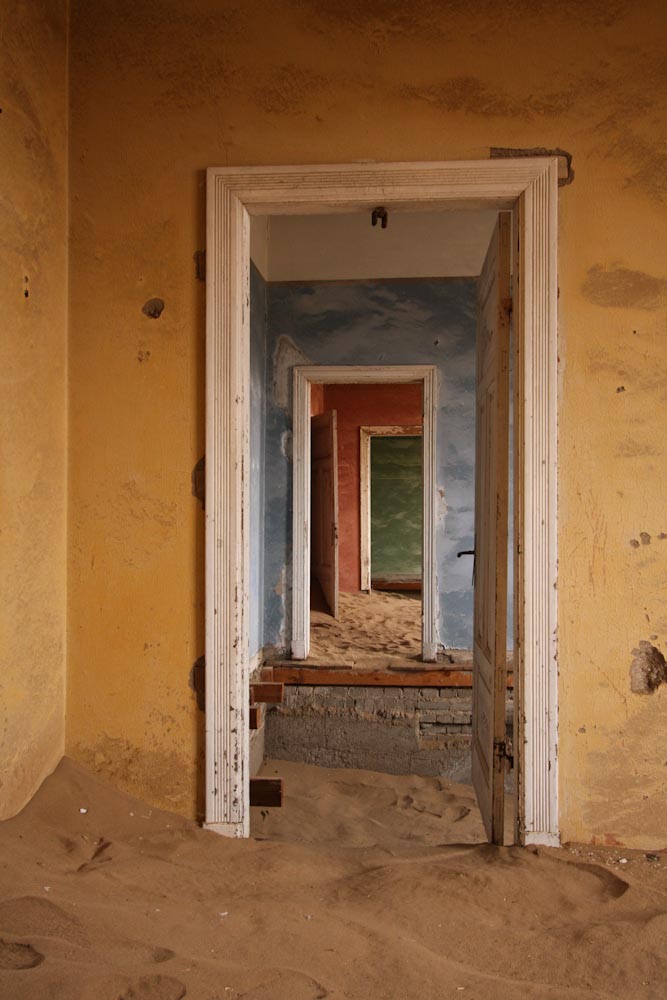
Tuesday, March 27 was the first stop in Namibia at Luderitz where we visited an old German town, founded in 1883. It was a trading post that began to boom when diamonds were found nearby in 1909. We first went to visit the abandoned mining village of Kolmanskop. It was very busy until 1954 when it was abandoned because there were no more diamonds. The sand and dunes were reclaiming the buildings, which made for some interesting pictures. It was also very foggy that morning.

Back in Luderitz we walked around the town and visited some of the old homes of the German dignitaries who lived there at one time. We were back aboard the ship for lunch and resumed sailing north. Jim Kelly gave a presentation on “The Biological Productivity of West African Coast Waters and Namibia’s Director of Tourism, Sema Shikongo, joined us and led a discussion on “International Perspectives from an African Perspective.”

March 28-29 we were docked in Walvis Bay. Paul and I have been here before, briefly. The bay is the only deep-water harbor along the whole west coast between somewhere in Angola and Cape Town and it is a very busy port. There were a number of options for tours on the two days and we seemed to make the right decisions, accidentally.

Wednesday morning we took the half-day Marine Cruise Tour that put us on a small boat cruising around the bay, learning about the area fishing and oyster industries. Pelicans and seals that know the boats came by for handouts of fish from the captain. These made for interesting photo ops. At the end, they served oysters on the half-shell (raw) and other snack items. I'll have to say that I could develop a liking for the oysters. They ship loaded up on them and on March 30 we had them again out on the back deck.

On the afternoon tour we went out to see the Treasures of the Namib, which took us to a dune for photos and then into the more mountainous area where the granite and volcanic dikes made an interesting landscape along with native plants.

At the end of that outing we went to a "sundowner" area for more oysters and then to a BBQ (buffet) dinner set in amongst the mountains. It was very nice and a local choir entertained us before the long drive back to the ship.

Thursday, March 29 we took the morning tour to Swakopmund, a town about 30 km away, and to Mondesa Township, which during colonial times was where Africans were required to live. We visited a couple of homes and talked to the residents to learn about them. One was an orphanage for HIV babies and children. We drove past the school set up and sponsored by Brad Pitt.
80 year-old Mayor of Township

It was very interesting so see that, although the people are very poor, by any standards, they have great pride in their homes and property. Everything was very neat, and the yards were all swept with no trash anywhere. We stopped briefly to meet the 80 year-old Mayor of the Township. She was a lovely lady.

Sandwich Harbour
After a quick lunch on board the ship, we headed out for the afternoon excursion, which took us on a long drive south to Sandwich Harbour. It is really just a bay now, where the dunes meet the sea. I climbed up the dune a little ways to get a spectacular view, and pictures. Again, we were served oysters!!!

On the drive back we went up over the dunes for a bit of a thrilling ride in the 4X4 vehicles. I thought it was great fun. Paul didn’t!

National Geographic Photographer Jay Dickman and the Photo Team Jack and Rikki Swenson were among the special staff aboard. We were lucky enough to have them and several other photographers and specialists in vehicles with us a few times.

Days At Sea: Flying Fish, Dolphins and Sunset
Friday – Saturday, March 30-31 were Days at Sea along the Skeleton Coast of Namibia, named for the bleached whale and seal bones and from the many shipwrecks caused by hitting rocks in the offshore fog. There were interesting lectures throughout the two days. The nice thing was that we could watch the lectures on the TV in our cabin while I worked on editing photos. I was just learning Lightroom, a new photo editing software to me, so it is great to have some time with Jack, Rikki and others to help me get started.

The weather turned very warm and when at sea, it was very pleasant out on deck where we saw flying fish, dolphins, whales and birds.

Next we spend two days in Angola.
 
That's it for now. Grace and Paul

West Africa Odyssey 2012 - South Africa


South Africa: Boulder’s Beach, Cape Town and At Sea

March 22 - 26, 2012
Aboard National Geographic Explorer


Paul and I took a Photo Expedition cruise with Lindblad called “Exploring Africa’s West Coast: An Odyssey from South Africa to Morocco” aboard the National Geographic Explorer, March 24 – April 29.

At that time of year Lindblad moves its ship from Antarctica, north to the high Arctic. We were aboard 34 days as we move up the West Coast, stopping in 17 different countries. The trip was an opportunity we could not resist.

Boulders Beach, South Africa
We left home March 20, flying through New York and on to Cape Town, South Africa via Johannesburg, arriving by noon March 22. We had arranged for a car and driver to take us down the east side of the cape to Boulders Beach where we stayed two nights with our photographer friends, Jack and Rikki Swenson.

African (Jackass) Penguins
It was a somewhat relaxing time where we enjoyed the African (Jackass) penguins, the beautiful view, good company, and tried to get over jet lag. We had been there for a brief visit in 2005 and were delighted to return. As always, time with the Swensons was full of adventure and photo ops.

Table Bay Hotel, Cape Town
Saturday, March 24, we left Boulders Beach for the hour long drive north to Cape Town where we checked into the Table Bay Hotel, right at the waterfront. It was near the busy and vibrant center of the city. We got lunch and walked around and enjoyed the flavor of the area before resting and getting ready for the welcome dinner that night. There were many new people to get to know. We found two couples and a single fellow with whom we had traveled before.

The "Twelve Apostles" mountains
Sunday, March 25 we had a bus tour around the city, but could not go up to Table Rock because of high winds. The cable car was shut down for the wind, and Paul would not have gone anyway. After a walking tour through the Kirstenbasch Botanical Garden, and lunch at the restaurant there, we returned to the hotel and out to an amphitheater on the waterfront.

Freshlyground Musical Group
The ethno-musicologist traveling with us as a staff member, had arranged for the top local singing group “Freshlyground” to perform a concert for us – and hundreds of locals gathered around to enjoy them with us. We had front center seats reserved. The music was interesting and the band fun to watch.

Grace, Jay, Rikki and Jack
When the concert ended and a short interview with the members concluded, we loaded back onto the buses for the short ride to our ship, the National Geographic Explorer, which was our home for five weeks.

As we left South Africa, there were the usual immigration and customs forms, check in and “get acquainted with the ship, cabin and unpacking” before the safety drill. This was our first time aboard Lindblad’s newest ship, but we found our way around quite well. This ship holds 150 passengers and it was full. Also there were 14 Guest Speakers and specialists besides the usual staff.

Monday, March 26 was a day at sea, and my morning started off with a latte in the Bistro while Paul got up. After breakfast we were introduced to all the special guest speakers, who we heard on days at sea. Other first day sessions included Rikki Swenson’s talk on Camera Essential, Richard White’s sessions on “Sea Birds of West Africa,” and Eugene “Doc” Mendoza discussed “Communicating with Africans.” Everything was interesting and there was so much to learn. The day ended with a “Welcome Aboard Cocktail Party with Captain Oliver Kruess, and then dinner.

The sea was very calm and we enjoyed getting to know new people. At that point we saw a fabulous trip ahead. Next stop was Namibia.

If you wish to receive a notice when I post the next entries, you can "Subscribe" below. It will generate an e-mail message to you. I have many more posts to go to cover the 17 interesting countries.

That's it for now. Grace and Paul