Monday, June 11, 2012

West Africa Odyssey 2012 - The Gambia

At Sea and The Gambia: Banjul

April 19-20, 2012
Aboard National Geographic Explorer

Thursday, April 19 was a relaxing day at sea sailing past Guinea and Guinea Bissau. The day was filled with lectures and picture editing. In the afternoon we had a “Super-sized Recap” which included a briefing on the next day’s plans.

Friday, April 20 found us in Banjul, The Gambia's, capital city. It is located at the mouth of the Gambia River. The Gambia is a long narrow country that stretches along both sides of the Gambia River. The country is only about 225 miles long and varies from about 20 – 30 miles wide. As with all the countries in the area, it was heavily involved in the slave trade and after the Portuguese, the British took over control; hence the official language is now English.

Again, we were greeting by music and acrobat troupes on the dock, performing for us as we disembarked for the morning tours.
 
Morning and afternoon tours basically split the passengers into two groups and rotated through six activities and stops. Our first stop was at the Lamin Lodge in the Tandi Wetlands area along the Gambia River. We boarded a double deck boat for a cruise to enjoy the mangrove trees and variety of birds.

Red Colobus Monkey
The second morning stop was at the Abuko Nature Center, a large protected area in the city with a large variety of birds and red colobus monkeys. We had a peaceful walk through the forest.

When we arrived back at the ship for lunch we found another market set up for our convenience. Following lunch we met in the lounge for a visit and discussion with employees from the US Embassy. Cindy Gregg, the chargé d’affaires represented the ambassador. Three others joined her. They all had a chance to describe their jobs and tell us how the US is helping The Gambia. There are now 84 Peace Corp Volunteers currently in the country. It was interesting to learn that girls are now staying in school and the students who go abroad for education are coming back home.

The afternoon outings took us first for a walk through part of the Serrekunda Market. The visit was just for the experience and not for shopping. The section we saw mostly sold clothing. Other groups visited different parts of the market.

Hoopoe Bird
Batik is the most widespread art form in The Gambia and we were taken to a factory where many sizes and designs are made. It is combined with a tie-dying technique that produces very interesting pieces. Several artists demonstrated their skill for us.

We returned to the ship with little time left to jump in the shower and get to the lounge for Recap.

The next day we were in Dakar, Senegal.

That's it for now. Grace and Paul

Saturday, June 9, 2012

West Africa Odyssey 2012 - Sierra Leone


Sierra Leone: Freetown

April 18, 2012
Aboard National Geographic Explorer

April 18, Freetown, Sierra Leone
This was an early morning with our pilot arriving on time around 6:00 AM and the immigration officials NOT needing a “face check” which means we don’t have to personally walk our passports passed them to be stamped. They just sit up in the Chart Room and stamp everyone’s passports. Meanwhile we were again treated to a performing group on the dock.

Paul finally fessed up to the doctor about having some intestinal problems and got quarantined and put on medication, so he couldn’t go on today’s outing, and wasn’t to leave the cabin except for a walk on the pier after everyone had left. (He was sprung loose in the evening and joined us for dinner, however.) I changed groups and took the city tour rather than the fishing villages tour, and the city tour turned out to be a great choice.

The drive through Freetown was very interesting. We had nice buses, but the streets are quite narrow with many small shops along the way. In the morning everyone seemed to be going to work; many walking, many on motorbikes and way too many cars for the streets. 

The people dress colorfully, although not as brightly as in Liberia, and the most common way to carry anything seems to be on their heads; men, women and kids. We visited a couple of museums and made a stop along the beach to listen to a band and dance group that performed for us. They had been on the pier as we were loading the buses and then caught up with us. The tour included a shopping opportunity where we could walk though a market place. My first purchase was a fan for $1. 

Lunch was served at a very nice hotel up on a hill overlooking the city and the bay. Again the music group was there to entertain us. At this point we could make a decision to either go on to visit a Chimpanzee Sanctuary or head back to the ship. I chose the latter and was glad I did, although the people who went to see the chimps were impressed with how the facility was taking care of animals that had been taken from people who had kept them as pets.  The hope is to eventually set them free as “family groups” in the wild.

Freed slaves from America and others who fought with the British settled Sierra Leone in the late 18th and early 19th century. They were sent first to Nova Scotia, and then migrated back to Africa. Sierra Leone had a very violent civil war from 1991 – 2002, but has made great strides towards peace and has successfully held elections since then. We heard about how the US is helping the country when the US Ambassador, Michael Owen, came to talk to us before dinner.

Shawn and Mustapha
We also had another guest aboard, Mustapha Wai, who was a refuge from Sierra Leone during the civil war. He went to America at the age of 18. There he met Shawn Davis, now one of our staff members, and they lived in the same apartment complex in Washington D.C.  Shawn was then in college and getting ready to go to Mali with the Peace Corp. Mustapha went on to finish college and now works in a high position with NASA, but happened to be in Freetown visiting relatives while we were there. It was a great reunion for them and was shared with us.

Sierra Leone Refugee All Stars
Yesterday afternoon they showed a movie titled “Sierra Leone’s Refugee All Stars” (1980s). Tonight that music group came aboard and performed a concert for us out on the back deck. Their music style is similar to Reggae with a real catchy rhythm so there was lots of dancing. Their story is amazing.

Tomorrow is a day at sea and we got to like those. There was lots of photo editing to do for me and there are always lectures spread out to take up our time as well. The day after will be The Gambia.

That's it for now. Grace and Paul

West Africa Odyssey 2012 - Liberia


Liberia: Monrovia

April 16 – 17, 2012
Aboard National Geographic Explorer

Monday, April 16 – At Sea to Monrovia, Liberia
Sunday evening (15th) at the Recap before dinner we learned a lot about the violent history of Liberia and how things are changing since the end of the civil war in 2005. 

President Ellen Johnson Sirleaf
The current President, Ellen Johnson Sirleaf was college educated in America with business degrees and in 2011, won the Nobel Peace Prize with two other African women for their contributions to stability and peace in their counties. She has recently been re-elected to a second term as president.

At the end of the briefing, we were told that she had accepted an invitation to come aboard that night for dinner and a talk, which was very exciting. There were also a couple of passengers on board whose son has a high position in the American Embassy in Liberia, so he and number of others from the embassy were scheduled to come. They were expecting some 48 guests in all: obviously not all for dinner as we can’t accommodate that many.

Since passenger ships have been having a difficult time getting permission to land in Liberia, we were going to arrive somewhere around 4:30 in the afternoon instead of in the morning, allowing lots of time for immigration and docking formalities. We hoped for the best. We were then getting back to some countries that are not used to having tourists and are only recently peaceful after years of internal wars. The recent history of these areas was almost more than we could absorb, but we were trying.

We would also be watching the news in the next week or so, because the ex-president of Liberia (Charles Taylor) is currently on trial in The Hague for horrendous war crimes in Sierra Leon and his sentencing is scheduled for April 26. (Update: he was found guilty and on May 30 sentenced to 50 years in prison.)

April 16 Liberia
After we had some lectures and I did a little picture editing during the day, our ship pulled alongside the port of Monrovia, Liberia about 4:00 in the afternoon. 

Soon there was a dance group performing for us on the pier to welcome us. The performance was provided by the local tour agent; a 27 year-old gal from Vermont. She went to Liberia to help get tourism going again after the civil war. While we were out along the rail watching, the expedition leader announced that the President would not be able to join us, but was sending the Vice President, Joseph Boakai, in her place.

Dignitaries started arriving about 5:30. We went to the lounge by 6:00 to have snacks and sodas and at 6:30 the whole entourage of over 40 people came in. Of course there was heavy security and their own media people as well. It turns out our visit was a REALLY BIG THING for Monrovia. Ours was the first cruise ship and group of tourists of this size (150 passengers) to visit in over 30 years. (Read and listen to the NPR report on our visit.)

Ralph Hammelbacher, the Lindblad employee who did all the planning and pre-trip visits to all locations, introduced the main people. The US Embassy representative, Carl Albrect, spoke about the ways the US is helping Liberia. Then Elizabeth Hoff, the Deputy Minister of Tourism and Culture spoke. Finally, the VP spoke. He had just returned from traveling around the US, visiting many cities including Phoenix, AZ, looking at continuing education systems that might help rehabilitate people in Liberia who have been fighting for so many years. He was impressed with the Phoenix Community College system. He then took and answered many questions from our passengers. The big way the US is helping the Liberian education system at the moment is through the 45 Peace Corp members in the country and they plan to bring in 30 more very soon.

A lady sat next to us who is the Finance Controller for the Port of Monrovia. She was very interesting. She fled to the US at the start of the civil war and only returned three years ago. She is now an American Citizen but wants to remain in Liberia to help improve her country.

VP in black shirt behind Paul
Eventually, dinner was served and we all went to the dining room followed by the VP and dignitaries who also ate. The security people stood around looking official and I’m sure others must have left because we could not seat them all.


Tuesday, April 17, Monrovia, Liberia
We took the Historic Tour of Monrovia, Africa’s oldest capital. It was interesting to see the many ruined buildings and how the country is patching things back together after it was so badly devastated. They have been making some good strides over the last 8 years of peace. We stopped at the Provident Baptist Church, Centennial Pavilion, the National Museum. 

On Snapper Hill we walked through the ruins of the once world-famous luxury Ducor Hotel. From there we had a panoramic view of the city and the bridge, which had been destroyed and just recently rebuilt by the Chinese. 

The stop at the Obaa Girls’ School was fun, as kids always are, and we left a number of large boxes of school supplies for them.

We were all back to the Explorer by about noon where we found a handicraft market set up for our convenience.

By 1:00 were having lunch and cast off, headed for Sierra Leone.

That's it for now. Grace and Paul

Thursday, June 7, 2012

West Africa Odyssey 2012 - Ghana


Ghana: Accra and Takoradi, 2 Days At Sea

April 13 – 16, 2012
Aboard National Geographic Explorer

Friday, April 13 found us docked very early in Accra, Ghana. Its first European contact was with Portugal in the 15th century and the British established the Gold Coast Crown colony in 1874. The Gold Coast gained independence from the UK in 1957 and was the first sub-Saharan African nation to become independent. They took back their old name of Ghana. Accra is the capital with a population of over 2.3 million. English is the official language.

We chose the Accra Highlights tour for the day and our big bus had a motorcycle police escort everywhere we went. It was a little embarrassing, but it did help in the heavy traffic. The first stop was a children’s orphanage opened in 1949 by Norwegian missionaries. It now houses 170 children ages 5-26. The next stop was the Kwame Nkrumah Memorial Park built to honor the first president of Ghana, who died in 1972. There was also a stop at the National Museum of History and Ethnology.

Lunch was served at the lovely Labadi Beach Hotel where we had a lively cultural show out on the lawn. It depicted the installation of a new king.

In the afternoon we visited the Artist Alliance Gallery where I was able to finally purchase some more West African Trade Beads in the form of bracelets. 

There we saw a large selection of specialty caskets made by a local casket maker. They were in all kinds of shapes from fish and trucks to a Coke bottle. The next stop was his workshop where he was working on a chicken-shaped casket, which would take him three days to complete. He had just been to Portland, Oregon for a workshop at the Oregon College of Arts and Crafts. Small world.

For the evening Recap in Accra, Ghana we were to have hosted the ex-president of the country. Unfortunately, because of a recent spine surgery, his doctor wouldn’t let him attend but his representative came aboard for dinner and conversation afterward. It sounded like we will be having other very interesting people come aboard later in the trip.

We had to say good-bye to one of our guest speakers, WadeDavis, and his daughter, Tara. He was such interesting fellow who has done so much and written about his experiences. We gained a new specialist who boarded to take his place, Harvey Feinstein. He was definitely not the dynamic personality and speaker as Wade, but was interesting. There were a number of ex-Peace Corps members aboard and also a number who had lived and worked in Africa.

Dinner was a special treat as we joined Jack and Rikki Swenson in the Chart Room for a more intimate dinner setting with two other couples. This was our third dinner in the Chart room; one with Richard White and one with Doc Mendosa.

Saturday, April 14 was spent in Takoradi, Ghana. Our first stop was the Albert Busomtwi-Sam fishing harbor. There was lots of activity, with the boats off-loading their catch and buyers bartering over prices. Although we needed permission to take pictures, a little flattery and cajoling usually won approval.

Cape Coast Castle, Swedes in 1650s
The next stop was the Cape Coast Castle built in the 1650s by the Swedes. It has changed hands between the British, Portugueses, Swedish, Danish and the Dutch like many other slave castles. It is now a UNESCO World Heritage Site and houses the West African Historical Museum created by the Smithsonian Institute. It was sobering to walk through the dungeons where the slaves were held before going out through the “Door of No Return” to awaiting ships to take them to the New World. Along the beach just outside was a very busy fishing village, which was very active with incoming catches of the day.

From there we went to another fishing village where we met the Chief and elders and were shown around the village. They specialize in smoking the small fish they catch. The kids from the local school came to see us and perform songs and dances. As usual we had a chance to dance with them. Again, the ship donated school supplies on our behalf.

Elmina Castle, Portuguese in 1482
Lunch was served at the Coconut Grove Beach Resort, a very good buffet, and then we made our last stop to see the exterior of the Elmina Castle, the oldest and largest European structure built in sub-Saharan Africa. It was built by the Portuguese in 1482 and was used as an auction market.

Each day of the trip was completely full from morning to night. Sometimes we returned to the ship just in time to jump in the shower briefly before heading to the lounge for the evening recap and then dinner.

Sunday/Monday, April 15 – 16. We were really ready for the next two days at sea, even though they were busy with lectures. 

Sunday afternoon there was an announcement that our Security Team (4 guys) was going to have to dispose of their ammunition and guns because they cannot have anything on the ship when we enter either Liberia or Sierra Leon. They fired off all their rounds from the back of the ship, dismantled the guns and dropped them overboard. When they finished, Andy, the head guy, showed me the paper that stated exactly how many rounds they shot off and the exact latitude, longitude and depth of water into which they dropped the dismantled guns. They stayed aboard until Senegal but by then we were out of dangerous waters.

There were some dolphin sightings on Monday.

Next to Liberia where we were the first passenger ship to visit in over 30 years!!!

That's it for now. Grace and Paul

West Africa Odyssey 21012 - Benin and Togo


Benin: Cotonou, Togo: Lomé

April 11 – 12, 2012
Aboard National Geographic Explorer

Wednesday, April 11 we were in Cotonou, Benin for a full day of sight seeing. There the official language is French. The region was referred to as the Slave Coast from as early as the 17th century because so many slaves were shipped from here to the New World. The last Portugese slave ship left Benin in 1885. The French took over when the slave trade ended and ruled until 1960 when Benin gained its independence. It became a democratic country in 1991.

The morning tour took us to a fort museum and then on to the Sacred Forest of Kpasse, which is located in a residential area but has special meaning for the locals. It is lined with statues of voodoo gods and is used in religious ceremonies. There was a local group dancing which made the visit more interesting.


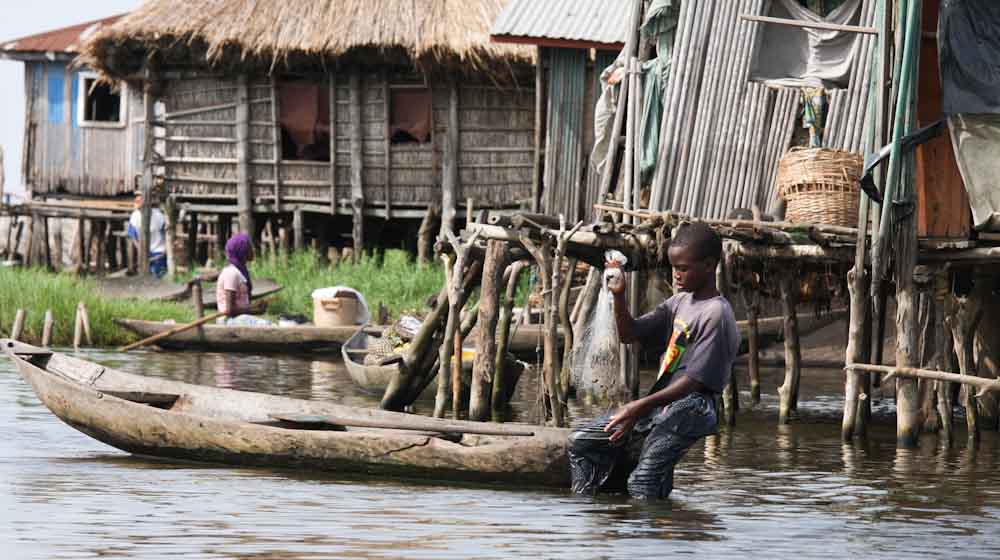
In the afternoon we drove out to Abomey-Calavi where we boarded motorized pirouges (10 people per boat) to travel out through Lake Nokoué to the lake village of Ganvié. This village was established back in 16th and 17th century as a safe haven for the local people because those looking for slaves would not go out into the water after them. 

The homes are built on stilts and about 30,000 Tofinu people live there. It was put on the UNESCO World Heritage Tentative list in 1996. The main industries besides tourism are fishing and fish farming. There was a local band playing at the site where we got off the boats and visited a couple of shops. It was fascinating how everyone used the small dugout boats for transportation, and in the afternoon they put up small sails to speed their return home.

Thursday, April 12 we were in Lomé, Togo. It is another long skinny country to the west of Benin, and it is another part of the “Slave Coast.” Germany claimed it as a protectorate, and then transferred it to France at the end of WWI. It gained its independence in 1960. French is still the official language.

The morning tour started with a visit to the largest Fetish Market or “pharmacie” in Africa. It stocks all the ingredients needed for traditional tonics and fetishes in the voodoo culture. While it was definitely not a tourist destination, it was indeed fascinating to see all the dried animal parts and dolls. Some even purchased good luck and travel fetishes.

The next stop was an Artisans’ Village where many different artist work and their pieces are available for purchase. I did buy a lovely batik from one of the artists. The last stop for the morning was the Hakuna Matata Cultural Centre were the famous Totolese puppeteer, Danaye Kanlefei, performed for us.

After lunch back onboard the ship we headed out for the afternoon to visit the Akato Viepe Village. Along the way we stopped at a local school to see the classrooms and royally disrupt their school day. The kids were fun and loved to have their pictures taken. The ship donated a lot of school supplies to them.

As we arrived at the village the women were sitting in one area waiting to sing and dance. There was a procession with the chief and his family who also enjoyed the dancing. I even got in some aerobic exercise trying to keep up with the dancers who were probably older than I am.

Back at the dock everyone had noticed that there was a Mercy Ship (hospital) docked nearby. A team from the ship came aboard to share what they do. They will be in Togo for quite a while performing special medical services around the country.

After dinner we were honored by a musical performance in the lounge by King Mensah, a very famous singer and musical group. There were other local musicians who came on aboard for evening performances before we left the dock.

Next we headed on to Ghana for stops at two ports over two days.

That's it for now. Grace and Paul